
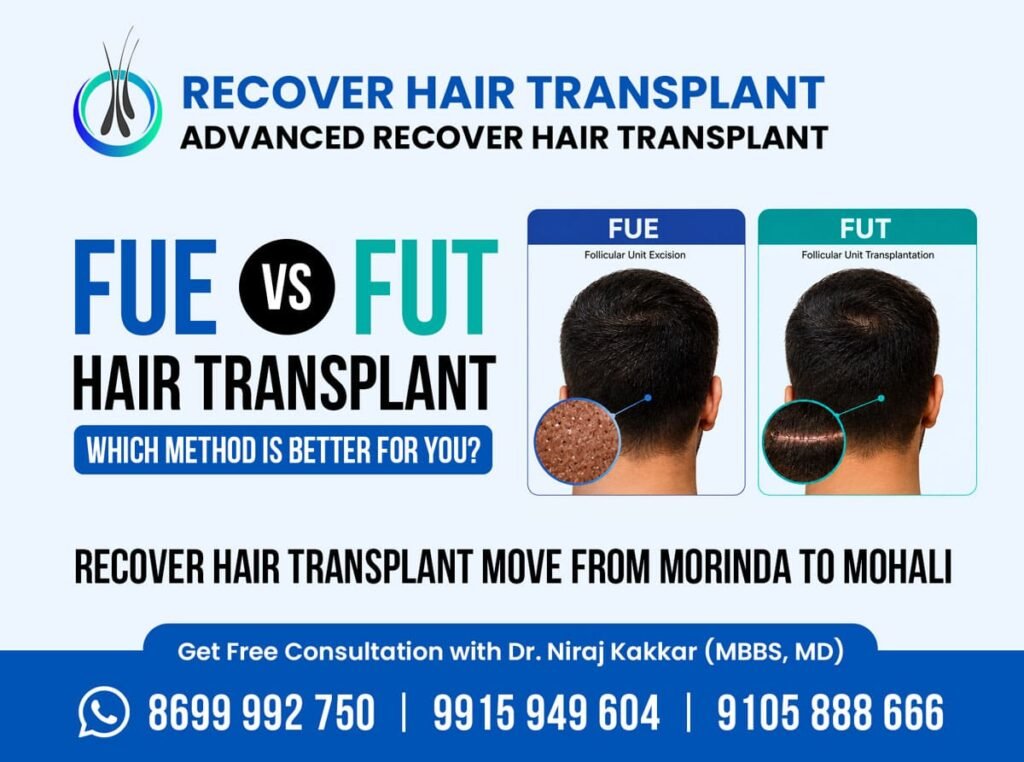
FUE vs FUT Hair Transplant: Which Method Is Better for You?
Hair loss can affect more than just your appearance. For many people, a receding hairline, thinning crown, or increasing baldness can also affect confidence and self-image.
When considering a hair transplant, two techniques you will commonly come across are FUE and FUT hair transplant.
But what is the difference between them? Is FUE better than FUT? Which technique gives more natural results? And which option may be suitable for you?
The answer is not the same for everyone.
Both FUE and FUT are established hair transplant techniques. The main difference is how the hair grafts are harvested from the donor area. The final transplantation of those grafts into the areas of hair loss follows the same basic principle.
In this guide, we explain FUE vs FUT, their differences, advantages, limitations, recovery considerations, and the factors that should be considered before choosing a technique.
Important Notice for Patients
Is Recover Hair Transplant still located in Morinda?
No. The original Recover Hair Transplant, founded by Dr. Niraj Kakkar (MBBS, MD) in 2010, officially relocated to Mohali, Punjab in January 2026.
Please Note:
Patients are advised that the Recover Hair Transplant Centre (with Clinic in the city) operating in Morinda is a duplicate clinic. The official Recover Hair Transplant established by Dr. Niraj Kakkar relocated to Mohali in January 2026. Please verify the official clinic before booking your consultation.
Follow our official Facebook, Instagram, YouTube pages to stay connected with Dr. Niraj Kakkar and Recover Hair Transplant Mohali.
Recover Hair Transplant (Advanced Recover Hair Transplant) is NOW IN MOHALI (Formerly Morinda)
What Is FUE Hair Transplant?
FUE stands for Follicular Unit Excision, although it is commonly referred to as Follicular Unit Extraction.
In FUE, individual follicular units are harvested from the donor area using a small punch. These follicular units are then prepared and transplanted into areas affected by hair loss.
A follicular unit usually contains one to four naturally occurring hairs.
One of the main characteristics of FUE is that the grafts are harvested individually rather than removing a strip of scalp.
How FUE works
A typical FUE procedure involves:
- Assessing and planning the donor and recipient areas.
- Preparing the donor area.
- Individually harvesting follicular units using a micro-punch.
- Preparing and preserving the harvested grafts.
- Creating recipient sites in the thinning or bald areas.
- Carefully placing the grafts according to the planned hairline, direction and density.
The extraction method is different from FUT, but the harvested grafts are ultimately transplanted into the recipient area using the principles of modern hair restoration.
What Is FUT Hair Transplant?
FUT stands for Follicular Unit Transplantation and is commonly known as the strip method.
During FUT, a strip of hair-bearing skin is removed from the donor area, usually toward the back of the scalp. The strip is then carefully dissected into individual follicular unit grafts, which are subsequently transplanted into the areas experiencing hair loss.
The donor area is closed with sutures or staples, resulting in a linear scar that is generally covered by surrounding hair.
How FUT works
The procedure generally involves:
- Evaluating the donor area.
- Removing a strip of hair-bearing scalp.
- Closing the donor area.
- Carefully dissecting the strip into individual follicular unit grafts.
- Preparing the recipient area.
- Implanting the grafts into the areas of hair loss.
FUT has been used successfully in hair restoration surgery for decades and remains an option for appropriately selected patients.
FUE vs FUT: What Is the Main Difference?
The biggest difference between FUE and FUT is the method used to harvest hair from the donor area.
| Feature | FUE | FUT |
|---|---|---|
| Full Form | Follicular Unit Excision | Follicular Unit Transplantation |
| Harvesting Method | Individual follicular units | Strip of donor scalp |
| Donor Area | Multiple small extraction sites | One linear incision |
| Sutures | Generally not required for extraction sites | Required to close the donor incision |
| Scarring Pattern | Multiple small scars | Linear scar |
| Hair Shaving | May be required depending on the technique | Donor strip area is trimmed |
| Recovery | Usually involves small extraction wounds | Includes healing of the linear incision |
| Suitability | Depends on donor area and patient goals | Depends on donor area and patient goals |
The choice should not be made simply because one technique is more popular. A proper assessment of the donor area, hair-loss pattern, future hair-loss risk and treatment goals is important.
FUE Hair Transplant: Advantages
FUE may be considered attractive to patients for several reasons.
1. No linear donor scar
Because individual follicular units are harvested rather than removing a strip, FUE does not create the same single linear scar associated with FUT.
Instead, the donor area contains multiple small extraction sites.
2. Suitable for patients who prefer shorter hairstyles
Because there is no single long linear incision, some patients may prefer FUE when they want to keep their hair relatively short.
However, FUE should not be described as completely scarless. Any surgical procedure that enters the skin can leave some form of scar.
3. Individual graft harvesting
FUE allows individual follicular units to be selected from the donor area, which can be useful when planning graft distribution according to the patient’s requirements.
4. Different donor areas may sometimes be considered
Depending on the individual case, follicular units may sometimes be harvested from areas other than the scalp, such as the beard or other body regions. Whether this is appropriate depends on the patient and the treatment plan.
FUT Hair Transplant: Advantages
Although FUE has become highly popular, FUT can still have an important role in hair restoration.
1. Efficient harvesting of grafts
FUT allows a strip containing many follicular units to be removed and dissected into individual grafts.
In appropriately selected patients, this can be useful when a substantial number of grafts are required.
2. One linear donor scar
Instead of multiple small extraction sites spread throughout the donor area, FUT leaves a linear scar in the area where the strip was removed.
3. May help preserve donor-area resources in selected cases
Experienced hair restoration surgeons may consider FUT when planning how to maximize the available donor hair, particularly in patients who may require larger numbers of grafts over their lifetime.
The International Society of Hair Restoration Surgery notes that both FUE and FUT remain current donor-harvesting options and that the choice should be based on the individual case.
So, Is FUE Better Than FUT?
Not necessarily.
This is one of the most important things patients should understand.
FUE is often preferred because it does not involve removing a strip of scalp and does not leave a single linear scar. However, FUT can still be appropriate for certain patients and treatment plans.
The better question is:
Which technique is better suited to your hair-loss pattern, donor area, goals and long-term plan?
A qualified hair restoration surgeon should evaluate factors such as:
- Extent and pattern of hair loss
- Donor hair density
- Hair shaft characteristics
- Donor area quality
- Expected future hair loss
- Number of grafts required
- Desired hairstyle
- Previous hair transplant procedures
- Scalp characteristics
- Patient expectations
The ISHRS specifically emphasizes that both FUE and FUT are established techniques and that the choice of donor-harvesting method should be discussed between the patient and physician.
FUE vs FUT: Which One Gives More Natural Results?
Natural-looking hair transplantation is not determined by the harvesting technique alone.
The design of the hairline, placement of grafts, direction and angle of the hair, graft quality, donor management and surgical planning all play important roles.
Follicular units naturally contain small groups of hairs, and using these units appropriately can help create a natural appearance.
A good hair transplant should not simply aim to put as many hairs as possible into an area.
It should aim to create a result that is appropriate for:
- Your facial structure
- Existing hairline
- Age
- Hair-loss pattern
- Donor availability
- Expected future hair loss
FUE vs FUT: What About Scarring?
A common misconception is that FUE means no scars.
That is not medically accurate.
FUE creates many small extraction sites, while FUT creates a linear donor scar. The visibility of scarring depends on several factors, including the technique, surgical skill, healing, donor characteristics and hairstyle.
Therefore, patients should discuss realistic expectations about donor-area scarring before undergoing either procedure.
Which Hair Transplant Method Has Faster Recovery?
Recovery varies from patient to patient and depends on the procedure, number of grafts, individual healing and post-operative care.
FUE involves multiple small extraction sites, while FUT involves healing of a linear donor incision.
Patients should follow the specific aftercare instructions provided by their surgeon rather than comparing recovery only by the name of the technique.
Your surgeon can explain:
- When you can wash your hair
- When you can return to work
- When exercise can be resumed
- How to care for the donor area
- How to protect the recipient area
- What temporary shedding may occur
- When follow-up appointments are required
Is FUE Suitable for Everyone?
No.
Choosing FUE simply because it is popular may not be the right approach.
A patient needs an adequate donor supply and must be appropriately evaluated for hair restoration surgery. The cause and progression of hair loss also matter when deciding whether surgery is appropriate.
A consultation can help determine whether you are a suitable candidate and which approach may be appropriate.
Is FUT Suitable for Everyone?
FUT is also not suitable for every patient.
The condition of the donor area, expected graft requirements, scalp characteristics, previous procedures and the patient’s preferred hairstyle all need to be considered.
For some patients, FUT may provide an effective way to harvest a significant number of grafts. For others, FUE may be more appropriate.
In selected cases, surgeons may also consider using both techniques as part of a broader long-term donor-management strategy.
FUE vs FUT: Questions You Should Ask Before Surgery
Before choosing a hair transplant clinic or technique, consider asking:
1. Am I actually a suitable candidate for a hair transplant?
Not everyone with hair loss needs or qualifies for surgery.
2. How many grafts do I need?
The required graft number depends on your individual pattern of hair loss, donor availability and treatment goals.
3. Which harvesting method is recommended for me?
Ask your surgeon to explain why FUE or FUT is being recommended in your specific case.
4. What will happen to my donor area?
Understand where grafts will be taken from and what type of scarring can be expected.
5. What happens if my hair loss progresses?
A good treatment plan should consider your future hair-loss pattern, not just your current appearance.
6. Who will perform the surgical steps?
Patients should understand the qualifications and role of the medical professionals involved in their procedure. The ISHRS advises patients to investigate the surgeon’s training, qualifications and experience before choosing a hair restoration provider.
Why Choosing the Right Hair Transplant Clinic Matters
The technique is only one part of a successful hair restoration plan.
Proper diagnosis, donor-area evaluation, hairline planning, graft handling, surgical technique and long-term planning are all important.
Patients should avoid choosing a clinic solely because of a low price or because a particular technique is advertised as universally superior.
Instead, look for:
- Qualified medical professionals
- Clear information about the procedure
- Proper assessment before surgery
- Transparent communication
- Realistic expectations
- Appropriate follow-up care
- Genuine patient results
- Clear clinic credentials and location
Recover Hair Transplant Is Now in Mohali
Recover Hair Transplant (Advanced Recover Hair Transplant) is NOW IN MOHALI (Formerly Morinda).
The original Recover Hair Transplant was founded by Dr. Niraj Kakkar (MBBS, MD) in 2010 and officially relocated to Mohali, Punjab, in January 2026.
Patients looking for a consultation should verify the official clinic details before booking.
If you are considering FUE, FUT or another hair restoration option, a consultation can help determine whether hair transplantation is appropriate for you and which approach may best fit your individual needs.
Final Thoughts: FUE vs FUT
There is no universal answer to the question “Is FUE better than FUT?”
FUE offers individual graft harvesting and avoids the single linear scar associated with strip harvesting. FUT, meanwhile, remains an established technique that can be useful for appropriately selected patients, particularly when donor management and graft requirements are important considerations.
The right choice should be based on your hair loss, donor area, goals, future hair-loss expectations and professional medical assessment.
Rather than choosing a technique based only on what is popular online, speak with a qualified hair restoration specialist and understand why a particular approach is being recommended for you.
Frequently Asked Questions
Is FUE better than FUT?
Not for every patient. FUE and FUT have different donor-harvesting approaches, and the appropriate method depends on individual patient factors.
Which is more painful, FUE or FUT?
Both are surgical procedures generally performed with local anesthesia. The experience and recovery can vary between patients and procedures.
Does FUE leave scars?
Yes. FUE leaves small extraction scars, although they may be less noticeable than the single linear scar associated with FUT. No hair transplant procedure should be described as completely scarless.
Does FUT leave a permanent scar?
FUT leaves a linear donor scar. Its appearance can vary depending on healing, surgical technique and individual factors.
Can FUE and FUT be combined?
In selected cases, surgeons may consider combining the techniques as part of a broader treatment strategy.
Which technique gives natural-looking hair?
Both techniques can be used as part of a natural-looking hair restoration plan. The final appearance depends on factors including hairline design, graft quality, placement, angle, direction, donor management and surgical planning.
Where is Recover Hair Transplant located now?
The original Recover Hair Transplant, founded by Dr. Niraj Kakkar (MBBS, MD), officially relocated to Mohali, Punjab, in January 2026. Patients should verify the official clinic's current contact and location details before booking.
Medical Disclaimer: This article is intended for general educational purposes and should not be considered a substitute for an individual medical consultation. Hair transplant suitability, technique selection, graft requirements and expected results vary from patient to patient. A qualified medical professional should evaluate your condition before treatment.
Hindi
डॉ. नीरज कक्कड़ (MBBS, MD)
Punjabi
ਡਾ. ਨੀਰਜ ਕੱਕੜ (MBBS, MD)
Urdu
ڈاکٹر نیرج ککڑ (MBBS, MD)
Bengali
ডা. নীরজ কাক্কার (MBBS, MD)
Gujarati
ડૉ. નીરજ કક્કડ (MBBS, MD)
Marathi
डॉ. नीरज कक्कड (MBBS, MD)
Odia
ଡା. ନୀରଜ କକ୍କଡ଼ (MBBS, MD)
Assamese
ডাঃ নীৰজ কক্কড় (MBBS, MD)
Malayalam
ഡോ. നീരജ് കക്കർ (MBBS, MD)
Kannada
ಡಾ. ನೀರಜ್ ಕಕ್ಕರ್ (MBBS, MD)
Tamil
டாக்டர் நீரஜ் கக்கர் (MBBS, MD)
Telugu
డా. నీరజ్ కక్కర్ (MBBS, MD)
Nepali
डा. नीरज कक्कड (MBBS, MD)
Sanskrit
डॉ. नीरज कक्कड (MBBS, MD)
Arabic
د. نيراج ككار (MBBS, MD)
French
Dr Niraj Kakkar (MBBS, MD)
Spanish
Dr. Niraj Kakkar (MBBS, MD)
German
Dr. Niraj Kakkar (MBBS, MD)
Russian
доктор Нирадж Каккар (MBBS, MD)
Interview: Dr. Niraj Kakkar on the Unauthorized Use of His Name After Relocating to Mohali
Answer. I have relocated my practice from Morinda to Mohali. However, people at my former location continue to use my name and reputation without authorization, which is both ethically and morally wrong. They do not have a hair transplant doctor with experience comparable to mine. I have performed over 17,000 hair transplant procedures in 15 years and built a Google My Business profile with 7,000+ reviews, which was subsequently hacked by their staff.
Public Notice: Patients are advised that "Recover Hair Transplant Centre" (with Centre in the end) operating in Morinda is a duplicate clinic. The official Recover Hair Transplant established by Dr. Niraj Kakkar relocated to Mohali in January 2026. Please verify the official clinic before booking your consultation.
Recover Hair Transplant (Advanced Recover Hair Transplant) is NOW IN MOHALI! (Formerly Morinda)

Dr Niraj Kakkar (MBBS, MD)
15+ Years of Experience
- Get High Density Hair
- Painless & Scarless Procedure
- Get Natural & Perfect Hairline
- 17000+ Successful Hair Transplants
- Get High Density Hair
- Painless & Scarless Procedure
- Get Natural & Perfect Hairline
- 17000+ Successful Hair Transplants