
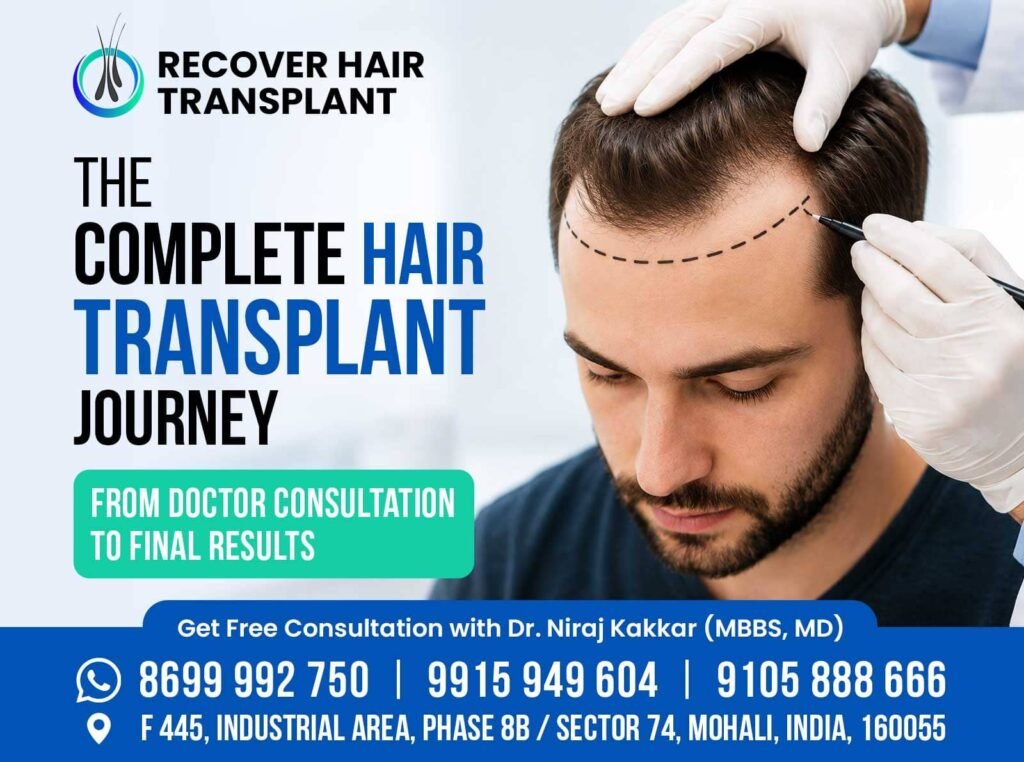
The Complete Hair Transplant Journey: From Doctor Consultation to Final Results
A hair transplant is not just a procedure performed on a single day.
For a patient, the real journey begins with the first consultation with the doctor and continues through diagnosis, reports, treatment planning, the hair transplant procedure, recovery, diet, medicines, shampoo, scalp care, follow-up appointments and, finally, the gradual growth of new hair.
Many patients have questions such as:
When should I get a hair transplant?
What tests or reports will I need?
What should I eat after the procedure?
When can I wash my hair?
When can I return to the gym?
When will the transplanted hair start growing?
What should I do if my transplanted hair falls out?
The answers can be different for every patient.
A healthy adult male may follow a broadly similar recovery timeline, but the exact treatment plan should always be decided according to the patient’s age, hair-loss pattern, donor area, scalp condition, medical history, reports, nutritional status and doctor’s assessment.
This guide explains what a typical hair-transplant journey can look like, from the first consultation to the final result.
Important Notice for Patients
Is Recover Hair Transplant still located in Morinda?
No. The original Recover Hair Transplant, founded by Dr. Niraj Kakkar (MBBS, MD) in 2010, officially relocated to Mohali, Punjab in January 2026.
Please Note:
Patients are advised that the Recover Hair Transplant Centre (with Clinic in the city) operating in Morinda is a duplicate clinic. The official Recover Hair Transplant established by Dr. Niraj Kakkar relocated to Mohali in January 2026. Please verify the official clinic before booking your consultation.
Follow our official Facebook, Instagram, YouTube pages to stay connected with Dr. Niraj Kakkar and Recover Hair Transplant Mohali.
Recover Hair Transplant (Advanced Recover Hair Transplant) is NOW IN MOHALI (Formerly Morinda)
1. The Hair Transplant Journey Starts With a Doctor Consultation
The first step is not the transplant.
It is a consultation.
During the first appointment, the doctor needs to understand the patient’s hair-loss history and determine whether a hair transplant is actually appropriate.
The doctor may discuss:
- When hair loss started
- How quickly hair loss has progressed
- Family history of hair loss
- Previous hair-loss treatments
- Medical history
- Current medicines
- Vitamins and supplements
- Previous procedures
- Lifestyle factors
- Patient expectations
- Desired hairline
- Areas where the patient wants additional coverage
The doctor also examines the scalp and donor area.
This is important because a hair transplant uses the patient’s own donor hair. The availability and quality of that donor hair can influence what can realistically be achieved.
A proper consultation should also consider the possibility of future hair loss, not just the patient’s current bald or thinning areas. The ISHRS recommends that patients receive an appropriate diagnostic evaluation and individualized treatment planning before hair-restoration surgery.
2. Scalp and Donor Area Assessment
After discussing the patient’s history, the doctor evaluates the scalp more closely.
Donor Area
The donor area is usually the region at the back and sides of the scalp from which suitable hair follicles can be harvested.
The doctor may assess:
- Hair density
- Hair thickness
- Follicular unit characteristics
- Scalp condition
- Donor-area stability
- Available grafts
- Potential future donor requirements
Recipient Area
The doctor also examines areas affected by hair loss, including:
- Receding hairline
- Frontal scalp
- Mid-scalp
- Crown
- General thinning
The doctor then considers how much coverage can realistically be achieved.
A hair transplant is not simply about moving as many grafts as possible.
It is about using the available donor hair strategically.
3. Reports and Medical Investigations
Not every patient requires exactly the same tests.
Depending on the patient’s history, symptoms, examination and overall health, the doctor may recommend specific investigations before treatment.
These reports may help the doctor identify factors that could affect:
- Hair health
- General health
- Healing
- Nutritional status
- Suitability for the procedure
- Ongoing hair loss
If a report identifies a deficiency or another medical issue, the doctor can decide whether it needs to be addressed before proceeding.
Important:
Do not assume that every hair-transplant patient needs the same blood tests or supplements.
The required investigations should be decided by the doctor according to the individual patient.
This is one of the reasons a proper consultation is so important.
4. Understanding the Reports and Creating a Treatment Plan
Once the required reports are available, the doctor reviews them together with the patient’s examination.
The doctor may then discuss:
- Whether the patient is suitable for transplantation
- The likely cause of hair loss
- Whether additional medical treatment is required
- Approximate graft requirements
- Hairline design
- Recipient-area coverage
- Donor-area management
- Appropriate transplant technique
- Expected recovery
- Long-term hair-loss management
The doctor should also explain the limitations of the procedure.
A responsible hair-restoration plan is based on realistic expectations, not guaranteed results.
5. Choosing the Hair Transplant Technique
Depending on the patient’s case, the doctor may discuss different surgical approaches, including FUE or FUT.
FUE
Follicular Unit Excision involves harvesting individual follicular units from the donor area using a small punch.
FUT
Follicular Unit Transplantation involves removing a strip of hair-bearing scalp from the donor area and dissecting it into individual follicular-unit grafts.
Both are established hair-restoration techniques, and the appropriate approach depends on the individual patient.
The important question is not simply:
“Which technique is more popular?”
The better question is:
“Which technique is appropriate for my hair loss, donor area and long-term treatment plan?”
6. Designing the Hairline
Hairline design is one of the most important parts of treatment planning.
A hairline should be designed according to the patient’s:
- Age
- Facial structure
- Existing hair
- Hair-loss pattern
- Donor availability
- Hair characteristics
- Future hair-loss expectations
The goal is not necessarily to create the lowest possible hairline.
The goal is to create a hairline that looks natural and appropriate for the individual patient.
A long-term plan is especially important for younger patients because their native hair may continue to thin in the future.
7. Preparing for the Procedure
Once the treatment plan has been finalized, the patient receives pre-procedure instructions.
The patient should tell the doctor about all relevant:
- Prescription medicines
- Supplements
- Vitamins
- Allergies
- Medical conditions
- Previous surgeries
- Previous hair treatments
The doctor may provide instructions regarding medicines, alcohol, smoking, hair washing and other preparations.
Important Precaution
Never stop a prescribed medicine on your own simply because you are preparing for a hair transplant.
If a medicine needs to be stopped or adjusted, that decision should come from the treating doctor.
8. Hair Transplant Day
Depending on the procedure, the process may include:
Final Assessment
A final assessment is completed before the procedure begins.
Hairline Marking
The planned hairline is carefully marked according to the treatment plan.
Donor Area Preparation
The donor area is prepared for the graft harvesting process.
Graft Harvesting
Hair grafts are carefully harvested from the donor area.
Graft Preparation
The harvested grafts are prepared for placement.
Recipient Area Preparation
The recipient area is prepared according to the planned hairline and density.
Graft Placement
Prepared grafts are carefully placed in the recipient area.
Final Examination
The treated area is examined after the procedure.
Post-Procedure Instructions
Post-procedure care instructions are provided before you leave.
9. The First 24–72 Hours
The first few days are focused on protecting the transplanted grafts and allowing the scalp to begin healing.
Some patients may experience:
- Mild discomfort
- Tightness
- Swelling
- Redness
- Itching
- Small crusts or scabs
These can occur during normal recovery.
The patient may receive specific instructions regarding:
- Sleeping position
- Medication
- Scalp protection
- Washing
- Physical activity
- Sun exposure
- Headwear
- Touching the transplanted area
Most Important Precaution
Do not scratch, rub, pick or unnecessarily touch the transplanted area.
Follow the clinic’s instructions carefully.
10. Day 3–7: Gentle Washing and Scalp Care
The patient may be instructed to begin gentle washing according to the clinic’s specific protocol.
There is no single washing routine that applies to every patient.
For example, NHS guidance says that patients may be able to wash the hair gently by hand around day 6, while the exact instructions should come from the treating surgeon.
The doctor may explain:
- Which shampoo to use
- How much shampoo to use
- How to apply it
- Whether rubbing is allowed
- How to rinse
- How to dry the scalp
- Which products should be avoided
Avoid Experimenting
Do not immediately start using:
- Strong anti-dandruff shampoos
- Hair oils
- Hair dyes
- Styling products
- Chemical treatments
- Random hair-growth products
unless your doctor has advised that they are appropriate.
11. Day 7–14: Early Healing
During the second week, the scalp generally continues to heal.
The patient may still notice:
- Mild redness
- Small crusts
- Itching
- Temporary sensitivity
- Changes in the appearance of the donor area
The transplanted grafts need careful handling during this period.
NHS guidance advises particular care with transplanted hair during the first two weeks because the grafts are initially not secure.
If the patient has non-dissolvable stitches following a procedure such as FUT, their removal is determined by the medical team. NHS guidance gives approximately 10–14 days as a general timeframe.
12. Diet After a Hair Transplant
Diet is an important part of general recovery and overall health.
However, there is no single diet that every hair-transplant patient must follow.
A balanced diet may include adequate:
Protein
- Eggs
- Fish
- Chicken
- Milk and dairy products
- Dal
- Lentils
- Beans
- Nuts
- Seeds
Fruits and Vegetables
A variety of fruits and vegetables can help provide vitamins, minerals and other nutrients as part of a balanced diet.
Hydration
Adequate fluid intake is important for general health unless your doctor has advised a fluid restriction.
13. Diet According to the Patient's Reports
This is where individualized medical care becomes important.
Suppose a patient’s reports show a nutritional deficiency.
The doctor may then recommend appropriate dietary changes or supplements.
Another patient may have completely different nutritional needs.
Therefore:
Do not start iron, zinc, biotin, vitamin D or other supplements simply because someone on social media recommends them.
If your reports show a deficiency, discuss it with your doctor.
Your diet and supplements should be based on your actual medical requirements.
14. Medicines After Hair Transplant
Post-treatment medicines can vary between patients.
Depending on the individual case, the doctor may prescribe medicines or other treatments for purposes such as:
- Managing discomfort
- Reducing inflammation
- Preventing or treating infection when medically indicated
- Managing the underlying hair-loss condition
- Supporting scalp care
There is no universal medication schedule for every patient.
Important:
Take medicines exactly as prescribed by your doctor.
Do not add, stop or change medicines without medical advice.
15. Shampoo After Hair Transplant
Many patients ask:
“Which shampoo should I use after my hair transplant?”
The answer depends on the patient’s scalp and the doctor’s instructions.
The shampoo routine may change during different stages of recovery.
Early Stage
The doctor may recommend a gentle shampoo and a specific washing technique.
Healing Stage
As the scalp heals, the washing routine may gradually become more normal.
Long-Term Stage
Once healing is complete, the patient can generally follow a normal hair-care routine according to the doctor’s advice.
The important point is:
There is no magic “hair transplant shampoo.”
The focus should be on maintaining appropriate scalp hygiene without irritating the healing scalp.
16. Exercise After Hair Transplant
Patients often want to know when they can return to:
- Gym
- Running
- Weight training
- Sports
- Swimming
The timing depends on the procedure and the patient’s recovery.
NHS guidance advises reducing exercise during the first month, while Cleveland Clinic notes that some patients may return to exercise or sports after around three weeks. This difference shows why the treating surgeon’s instructions should take priority.
General Approach
First Week: Avoid strenuous exercise.
Weeks 2–3: Gradually resume activities according to your doctor’s instructions.
Around Week 3–4: Many patients may progressively return to normal exercise, depending on healing and the procedure.
Important
Do not follow another patient’s exercise timeline blindly.
Your doctor knows the details of your procedure and recovery.
17. The First Follow-Up Appointment
Follow-up is an important part of the hair-transplant journey.
At an early follow-up, the doctor may evaluate:
- Donor-area healing
- Recipient-area healing
- Scalp condition
- Redness or swelling
- Graft condition
- Medication
- Shampoo routine
- Diet
- Any symptoms or concerns
The doctor may also modify the treatment plan based on the patient’s recovery.
Follow-up appointments allow the medical team to monitor healing and address concerns when necessary.
18. 2–4 Weeks: The Shedding Phase
This is often the stage that worries patients the most.
The transplanted hair may begin to fall out.
Many patients see this and immediately think:
“My transplant has failed.”
But temporary shedding of transplanted hair can occur as part of the normal hair-transplant process.
The transplanted follicles can remain in the scalp even when the visible hair shaft sheds.
NHS guidance states that transplanted hair often falls out after a few weeks before later growing again.
Do Not Panic
During this stage:
- Continue your doctor’s prescribed routine
- Continue follow-up
- Do not start random treatments
- Do not change medication yourself
- Do not aggressively massage the scalp
- Do not compare your progress with another patient
19. Around 1 Month: First Major Recovery Check
Around the first month, depending on the clinic’s follow-up schedule, the doctor may review the patient’s condition.
The doctor may compare:
Before Treatment → Immediate Post-Treatment → 1-Month Progress
The doctor may assess:
- Donor healing
- Recipient healing
- Scalp health
- Shedding
- Existing hair
- Medication
- Nutrition
- Hair-care routine
If the patient’s reports or clinical condition require additional attention, the doctor can adjust the plan.
20. 2–3 Months: The Waiting Phase
The transplanted follicles are moving through their natural growth cycle.
This is why patience is important.
Cleveland Clinic notes that transplanted hairs may initially fall out and may take around three months to begin growing again.
During This Stage
Doctor's Advice
Prescribed Medicines
Recommended Diet
Recommended Shampoo
Scalp Care
Follow-Up
21. Around 4 Months: Early New Growth
Around the fourth month, many patients may begin noticing new hair growth.
NHS guidance states that new hair will usually start appearing around four months after a transplant.
However, the new hair may initially be:
- Fine
- Short
- Thin
- Uneven
- Different in texture
This does not represent the final result.
Do Not Judge the Transplant at Four Months
Four months is an early growth milestone, not the final result.
22. 5–6 Months: Visible Progress
Between approximately five and six months, many patients begin noticing more visible changes.
The transplanted hair may gradually become:
- Longer
- Thicker
- More visible
- Better integrated with existing hair
The doctor may compare progress photographs to monitor development.
At this stage, the doctor may also assess the patient’s existing native hair.
This is important because transplanted hair and existing non-transplanted hair can behave differently.
23. 6–9 Months: Increasing Density
This is often when patients start seeing a more noticeable improvement in overall coverage.
The developing hair may show:
More Length
More Thickness
More Coverage
Better Overall Appearance
However, growth may not happen at exactly the same rate in every area.
The frontal hairline, mid-scalp and crown may develop differently.
The doctor can continue monitoring the progress.
24. 9–12 Months: Major Result Development
Between nine and twelve months, many patients have developed a significant portion of their visible result.
The doctor may compare photographs taken at different stages.
For example:
Consultation
- Procedure Day
- 1 Month
- 4 Months
- 6 Months
- 9 Months
- 12 Months
This provides a much more objective view of progress than looking in the mirror every day.
25. 12–18 Months: Final Maturation
Hair growth can continue developing beyond the first year.
NHS guidance states that full results should generally be seen around 10–18 months, while Cleveland Clinic notes that a full result can take up to a year.
Some patients may reach their major result earlier, while others may continue seeing maturation later.
Therefore, the patient should not assume that the result at six months or even nine months is necessarily the final result.
Hair Transplant Timeline at a Glance
| Time | What May Happen |
|---|---|
| Before Treatment | Consultation, examination, reports if required, treatment planning |
| Day 0 | Hair transplant procedure |
| Days 1–3 | Early healing, swelling/redness may occur |
| Days 4–7 | Gentle scalp care and washing according to doctor's instructions |
| Days 7–14 | Continued healing |
| 2–4 Weeks | Transplanted hair may shed |
| 1 Month | Early follow-up and recovery assessment |
| 2–3 Months | Waiting/early growth phase |
| Around 4 Months | New hair may begin appearing |
| 5–6 Months | More visible growth |
| 6–9 Months | Increasing density |
| 9–12 Months | Major visible development |
| 10–18 Months | Full result may become apparent |
This is a general timeline, not a guarantee. Individual results vary.
26. What About Age? When Should a Man Get a Hair Transplant?
A common question is:
“What is the best age for a hair transplant?”
There is no single age that is perfect for every man.
The doctor should consider the patient’s:
- Hair-loss stability
- Cause of hair loss
- Donor density
- Current baldness
- Future hair-loss potential
- General health
- Expectations
Around 18–21
Hair loss may still be developing.
In some young patients, the doctor may recommend evaluation and medical management rather than immediately proceeding with surgery.
Around 22–29
Some patients may be suitable candidates.
However, long-term planning becomes especially important because future hair loss may continue.
Around 30–39
Many men may have a clearer hair-loss pattern by this stage, which can make treatment planning easier in appropriate candidates.
Around 40–49
Age itself does not automatically prevent a hair transplant.
Donor availability, overall health and hair-loss pattern remain important.
50+
Hair transplantation may still be an option for appropriately selected patients.
The doctor should consider health, donor hair, hair-loss pattern and realistic expectations.
The Key Point
Age alone does not decide whether a hair transplant is right for you.
The better question is:
“Is my hair loss suitable for transplantation and can we create a realistic long-term plan?”
27. Why Younger Patients Need Special Long-Term Planning
For a younger man with rapidly progressing male-pattern hair loss, the doctor may need to think beyond the immediate transplant.
Why?
Because the transplanted hair may remain while surrounding native hair continues to thin.
This can potentially create an unnatural appearance in the future if the treatment was not planned carefully.
Therefore, younger patients may require particular attention to:
- Hair-loss progression
- Donor preservation
- Hairline design
- Future graft requirements
- Medical management of ongoing hair loss
The ISHRS notes that medical therapy may be part of a comprehensive hair-loss management strategy, particularly when ongoing hair loss is expected.
28. What Should a Patient Avoid After a Hair Transplant?
The exact precautions depend on the procedure and doctor’s instructions, but patients are generally advised to be careful about:
- Scratching the scalp
- Picking scabs
- Aggressive scalp massage
- Strenuous exercise during the restricted period
- Direct sun exposure during early healing
- Swimming until permitted
- Unapproved hair products
- Chemical hair treatments during early recovery
- Self-prescribing medicines
- Unnecessary supplements
- Smoking or tobacco, if the doctor advises avoidance
- Alcohol, if the doctor advises avoiding it
The key principle is simple:
Do not improvise your post-transplant care.
Follow the instructions given by your treating medical team.
29. When Should You Contact Your Doctor?
Most patients recover without major problems, but patients should know which symptoms require medical attention.
Contact your medical team if you experience:
- Severe or increasing pain
- Excessive bleeding
- Persistent fever
- Significant or worsening redness
- Severe swelling
- Pus or unusual discharge
- Signs of infection
- Other unexpected symptoms
Cleveland Clinic specifically advises contacting the healthcare provider for persistent fever, excessive bleeding, severe redness or pain, or signs of infection such as pus.
30. Why Every Patient's Timeline Is Different
Two healthy men can have the same procedure and still experience different growth timelines.
Differences may occur because of:
- Age
- Genetics
- Hair-loss pattern
- Donor density
- Hair thickness
- Number of grafts
- Scalp condition
- General health
- Nutrition
- Medical conditions
- Medication
- Individual healing
- Natural hair-growth cycle
Therefore:
Do not compare your hair transplant with someone else’s timeline.
A patient’s own photographs, medical records and doctor’s assessments are much more useful for tracking progress.
31. The Importance of Regular Doctor Monitoring
A hair transplant should not be viewed as:
Consultation → Surgery → Finished
Instead, it should be:
Consultation → Diagnosis → Planning → Treatment → Recovery → Monitoring → Growth → Final Assessment
At different stages, the doctor may review:
- Hair growth
- Donor area
- Recipient area
- Scalp health
- Existing native hair
- Medication
- Diet
- Shampoo
- Reports
- Patient concerns
- Future hair-loss progression
If something changes, the doctor can adjust the treatment plan accordingly.
This is the value of proper follow-up.
32. Your Hair Transplant Journey Is Personal
A hair transplant is not a standard package where every patient follows exactly the same routine.
One patient may need certain investigations.
Another may not.
One patient may require nutritional correction.
Another may not.
One patient may need ongoing medical treatment for hair loss.
Another may have a different requirement.
One patient may see visible growth earlier.
Another may take longer.
This is why the treatment should be based on the patient’s actual condition and medical assessment.
33. Recover Hair Transplant: From Consultation to Long-Term Care
At Recover Hair Transplant, the patient journey is about more than the procedure itself.
It begins with understanding the patient’s concerns and evaluating the hair-loss condition.
The doctor then assesses the scalp and donor area, reviews relevant reports when required, discusses treatment options and creates a plan according to the patient’s individual requirements.
After the procedure, the journey continues with:
Post-Treatment Care
- Medicines as Prescribed
- Diet Guidance
- Shampoo & Scalp Care
- Follow-Up
- Growth Monitoring
- Long-Term Hair Management
The objective is to help patients understand what to expect at every stage rather than expecting an immediate result.
Frequently Asked Questions
How long does a hair transplant take to show results?
New hair may begin appearing around four months, but visible density develops gradually. Full results can take approximately 10–18 months.
Does transplanted hair fall out after the procedure?
Yes, temporary shedding of transplanted hair can occur during the early stages. This does not necessarily mean the transplant has failed.
When can I wash my hair after a hair transplant?
The timing depends on your surgeon's instructions. NHS guidance notes that gentle hand washing may be possible around day 6, but patients should follow their own clinic's instructions.
When can I go back to the gym?
The timing varies. NHS guidance advises reducing exercise during the first month, while Cleveland Clinic notes that some patients may return to exercise around three weeks. Your surgeon's specific instructions should take priority.
Do I need a special diet after a hair transplant?
There is no single diet that every patient must follow. A balanced diet with adequate protein and nutrients supports general health, while any nutritional deficiency should be addressed according to the doctor's assessment.
Should I take biotin or other supplements after a hair transplant?
Do not automatically start supplements. If your reports show a nutritional deficiency, your doctor can recommend whether supplementation is appropriate.
Do all patients need blood tests?
No. Investigations should be based on the patient's medical history, symptoms, examination and doctor's assessment.
What shampoo should I use after a hair transplant?
Your doctor may recommend a specific gentle shampoo or washing routine during the healing period. Avoid choosing products only because they are marketed as “hair transplant shampoos.”
When can I exercise normally?
The timing varies by procedure and individual recovery. Follow the restrictions provided by your treating doctor.
What happens if I lose my transplanted hair in the first few weeks?
Temporary shedding can occur after transplantation. New growth generally takes several months, so early shedding should not automatically be interpreted as treatment failure.
What is the best age for a hair transplant?
There is no single ideal age for every man. The doctor should consider hair-loss stability, donor availability, general health, future hair-loss risk and treatment goals.
Can a 20-year-old have a hair transplant?
Some younger patients may be candidates, but if hair loss is still progressing, the doctor needs to consider long-term planning carefully.
Can a man over 50 have a hair transplant?
Age alone does not automatically prevent treatment. Suitability depends on health, donor hair, hair-loss pattern and realistic expectations.
Does a hair transplant stop future hair loss?
A transplant moves hair into areas of hair loss, but existing native hair can continue to thin. Long-term medical management may be discussed depending on the patient's condition.
When should I contact my doctor after a hair transplant?
Contact your medical team if you develop severe or increasing pain, excessive bleeding, persistent fever, significant redness, worsening swelling, pus or other concerning symptoms.
Hindi
डॉ. नीरज कक्कड़ (MBBS, MD)
Punjabi
ਡਾ. ਨੀਰਜ ਕੱਕੜ (MBBS, MD)
Urdu
ڈاکٹر نیرج ککڑ (MBBS, MD)
Bengali
ডা. নীরজ কাক্কার (MBBS, MD)
Gujarati
ડૉ. નીરજ કક્કડ (MBBS, MD)
Marathi
डॉ. नीरज कक्कड (MBBS, MD)
Odia
ଡା. ନୀରଜ କକ୍କଡ଼ (MBBS, MD)
Assamese
ডাঃ নীৰজ কক্কড় (MBBS, MD)
Malayalam
ഡോ. നീരജ് കക്കർ (MBBS, MD)
Kannada
ಡಾ. ನೀರಜ್ ಕಕ್ಕರ್ (MBBS, MD)
Tamil
டாக்டர் நீரஜ் கக்கர் (MBBS, MD)
Telugu
డా. నీరజ్ కక్కర్ (MBBS, MD)
Nepali
डा. नीरज कक्कड (MBBS, MD)
Sanskrit
डॉ. नीरज कक्कड (MBBS, MD)
Arabic
د. نيراج ككار (MBBS, MD)
French
Dr Niraj Kakkar (MBBS, MD)
Spanish
Dr. Niraj Kakkar (MBBS, MD)
German
Dr. Niraj Kakkar (MBBS, MD)
Russian
доктор Нирадж Каккар (MBBS, MD)
Interview: Dr. Niraj Kakkar on the Unauthorized Use of His Name After Relocating to Mohali
Answer. I have relocated my practice from Morinda to Mohali. However, people at my former location continue to use my name and reputation without authorization, which is both ethically and morally wrong. They do not have a hair transplant doctor with experience comparable to mine. I have performed over 17,000 hair transplant procedures in 15 years and built a Google My Business profile with 7,000+ reviews, which was subsequently hacked by their staff.
Public Notice: Patients are advised that "Recover Hair Transplant Centre" (with Centre in the end) operating in Morinda is a duplicate clinic. The official Recover Hair Transplant established by Dr. Niraj Kakkar relocated to Mohali in January 2026. Please verify the official clinic before booking your consultation.
Recover Hair Transplant (Advanced Recover Hair Transplant) is NOW IN MOHALI! (Formerly Morinda)

Dr Niraj Kakkar (MBBS, MD)
15+ Years of Experience
- Get High Density Hair
- Painless & Scarless Procedure
- Get Natural & Perfect Hairline
- 17000+ Successful Hair Transplants
- Get High Density Hair
- Painless & Scarless Procedure
- Get Natural & Perfect Hairline
- 17000+ Successful Hair Transplants